Showing posts with label D. Assignment 3: Factual Programmes. Show all posts

Thursday, 30 June 2016

The nature and purposes of research in the creative media industries

Primary research is new information that you have found and collected yourself. This can include surveys, focus groups and interviews. I did a questionnaire to find out about my idea and some of the questions I might ask in my documentary. I started by asking about the interest in my idea as it can be a boring topic to talk about, however the feedback came back positive so I carried on with the idea. I found questions that I could ask in the documentary and put them on the questionnaire as I wanted mix of responses for each question in the documentary and if the answers came back similar I wouldn't ask that question in the documentary, some I decided to use based on the questionnaire.
In the professional industry they would do something similar to find out what works well and what doesn't they would either do what i did and do a questionnaire or would do a focus group and would do these to get the public's feedback on their idea.  


Secondary research is old information that someone else found and you use to get a better understanding on the topic. There are many ways of getting secondary research such as Books, journals, reference-based books and directories, periodicals, newspapers, film archives, photo libraries, worldwide web, searching internet forums, I got a few different types of secondary research such as reports, news reports and documentary's. I used this to get a better understanding of my topic so i could ask relevant questions to try and get a new spin on the topic.
Quantitative research is information on figures that you use as research to find out if your topic is popular or not. A few examples of quantitative research are programme ratings, readership circulation figures, hits on a website, box office figures, sales of CD's and DVDs. I didn't need to use this type of research as I already had primary research telling that people would be interested so I didn't need to look figures.


Qualitative research is information that is by an individual essentially reviewing a product/topic and giving their views and opinions on it. A few examples are film reviews, game reviews, fanzine website, responses to news coverage, discussion. I didn’t use much of this as I didn’t think it was necessary as I didn’t need to know if it was controversial because politics is always controversial. I used it a little bit to find out if this topic is talked about enough to make a documentary and it was but i didn’t do enough research to note it on my research page.


Data gathering agencies have the purpose of taking information on media and displaying it to the public. They give information on how popular the certain media is and if it worth looking at.  The first example of this that I know is BARB figure which is a collection of data showing how many people are watching a TV channel at all times. This is helpful as you might want to look at a time to put your advert on a channel or use it to find out if a topic you are planning on using for your own project is getting lots of views. The second example is IMDB which is a website that reviews movies and TV shows and also gives you a rating on how good it is. This website gives you data on how popular all movies and TV show are.


Audience and market research is just essentially asking the public for feedback on the product you are planning to make and make changes based on the feedback. This could be done in many ways such as questionnaires, focus groups and researching your demographic and geographic. I used a questionnaire to get a good idea of what my audience is and researched the topic in depth to get the right questions for my documentary. I didn't do much as i already knew what my target audience was going to be and i started for there.   


Production research is the research that is done just before the production starts which includes location research and scouting, Personnel recruiting and finance research. This is a crucial part of a production as this what all of the filming relies on, if you get the locations wrong you could ruin the whole production. I used location recces to essentially scout the location of my choice to see if it would work. I didn't use no personnel i did it all myself however i had to get people to be in the production so i planed ahead to get people to act in the production.   
      

Monday, 16 May 2016

Documentary Formats

 La sortie des usines Lumière: This is a short Documentary with no speech. It is essentially the employees of the people filming leaving work after hours. This is authentic as there would be no reason to fake this as it is a normal thing that would happen every working day. The soundtrack is a quite tune in the background to go with what is going on screen.

Bowling for Columbine: This is a Documentary about the gun laws in the America and why it is a problem. The man in the documentary is very passionate about the laws being stricter and because of this he is quite bias and edits the documentary to prove his point and does not cover the whole story. He edits the beginning scene to make it seem like he got a gun in one day when in actuality it had taken weeks to have a background check on him and he has just put the same clothes to make it seem like the same day. This isn't as authentic as it could be as it lies to the audience to trick them into think the situation is worse than it actually is and also cuts the part of the conversation that might go against the point of the documentary.     

Documentary Types

A documentary is a type of media that is similar to a film 
however more informative and is used to educate or explain a topic or subject. Documentaries most commonly take facts, figures and information and gets professional of the subject to talk about and explain it for viewers to learn. Documentaries can also be used in many other ways such as a documentary used as evidence in a court case as it was made to show that the man falsely accused was innocent and proved that the case did not add up properly and ended up getting the man released. Documentaries can also be used to retell a story or event from different points of view to get a better understanding on what actually happened. Documentaries have other types of plots such as interviewing a certain people or person to get a better understanding of how they live and why they have certain beliefs, this can also be to interview famous people to see what they think about from day to day and what their life consists of. My definition of documentaries is that it is a film based on facts and true events to educate and inform. There are different of Documentaries such as Expository, Observational, Interactive, Reflexive, Performative I will give an example and an explanation of each of these. 

https://www.youtube.com/watch?v=NLuG0CO7gEQ
Expository documentaries are normally informative and speak directly to the audience with voiceovers from professionals on the subject who use their knowledge to make a strong argument and has point of view throughout. Expository documentary also tries to persuade the audience by using a certain voice to captivate the viewer such as David Attenborough who has a strong deep voice giving a knowledgeable tone to his voice persuading the listener to believe the information that he gives. The example I found for Expository documentaries is an underwater nature documentary called “The blue planet” created and produced by the BBC, it premiered on 12 September 2001 in the United Kingdom. This is a series of documentaries about the ocean and what lives and goes on underneath the surface. The voice over is done by David Attenborough who is probably the most famous nature documentary narrator. It uses a strong, trustable tone of voice persuades the audience into taking all of the information seriously and not doubting the authenticity. This also speaks directly to the audience by aiming the information told to teach the audience, so when explaining something it is intended to be direct to the viewer. 

https://www.youtube.com/watch?v=85WGQhMlQX0


Observational documentaries are the representation of someone’s life using footage music and voice over’s to show the life and story of someone. It has no interaction between the filmmakers and the subject of the documentary. It essentially follows the subject around as they live the life to show their story. It uses footage, dialogue and music to tell the subjects story. Documentary directors use this type to get intimate with the subject and tries to get the audience to relate to the subject and understand his struggles and beliefs. The example I found was a documentary about teen from a poor family who lives in a ghetto and is trying to become a professional basket player and is cal ''Hoops dream''. It follows him on the journey to becoming a semi-professional. It uses footage of him playing basketball and dialogue from him, his friends and family. By the end you relate to his ambition and his desire which makes you want to route for him.

https://www.youtube.com/watch?v=D_-kzVP00qI


Reflexive documentaries are documentaries that make you think about the outcome and very much focus on mentally challenging the viewer to decide if it was authentic or not, usually done by interviewing different people with different interpretations of events and facts to make stories and information overlap and not fit together. It is essentially used to see different sides of a topic or event from various types of people from different backgrounds and lifestyles. The example I chose was a documentary called “The most hated family in America” which is a documentary about the core members of the Westboro Baptist Church which is a religious group who say very controversial comments about Jewish and Homosexual people and essentially throw hate at them. Their beliefs are very much against certain groups of people believing that God wants them to condemn these certain people. By the end of this documentary you left questioning if these people are real or if they put it on as an act as their beliefs are all over the place and are basically just trying to put all of the world's issues on certain people which is completely unethical. After watching this documentary it left me thinking about the world as a whole and actually left me disappointed that anyone could have these kind of beliefs.

http://www.disclose.tv/action/viewvideo/185403/Night_and_Fog_1955/

Per-formative documentaries are re-enactments of a certain events or subjects that have people who were involved or know about the topic/event. These types of documentaries usually have the people involved in the event to retell the event from their point of view meaning that it isn't always one-hundred percent accurate. They can also have the people involved to re-enact the event like a play giving their thoughts and feelings on what happened, this was used in the “Act of killing” where mass murderers were told to re-enact what they did to their victims. These types of documentaries are usually very personal and deal with dramatic events getting the emotion from the people in involved and emotions from the person being interviewed. My example is “Night and Fog” which is a documentary made ten years after the liberation of Nazi concentration camps talking to survivors and others involved discovering more about what actually happened and got the thoughts and feeling of who was involved.         


https://www.youtube.com/watch?v=JPmk7I0A8k8

Interactive documentaries are  documentary's that has interaction with the filmmakers and the people being filmed and throughout the documentary there is communication from the man behind the camera, in some cases are actually on camera and can be seen. It is essentially just the person behind the camera who would not be heard or seen have a massive presence. The example I have chosen was “Bompton” which is a documentary about Compton and the massive issues they have with gang violence. This is mainly based around the famous rapper Kendrick Lamar who grew up in Compton and due to his fame has been able to leave. This documentary follows him as he revisits his past and talks about his struggles and beliefs. It also follows his friend’s stories and how they dealt with the day to day struggle that Compton gave them. In this documentary you can see the filmmaker giving interviews and can also be heard giving his opinion and asking further questions to what is said. 

In conclusion I believe that all of the documentary types have their own benefits and drawbacks however my personal favorite is the observational documentary i love the idea of following a real person around and finding out about his/her life and seeing their story unfold. This is also very authentic as it follows someones life which means they cant lie about them self. The point of this type from a directors view is to not have a opinion on the subject and not be bias which also links into authenticity as if the director inst being bias then the audience wont be lent to a certain side and can have their own opinion.    


Introduction to News

I watched BBC News at ten 10/04/2016 airing at 10PM
http://www.bbc.co.uk/iplayer/episode/b076zsm1/bbc-news-at-ten-10042016

This news broadcast started with a roundup of some of the stories that was going to be covered in the program and then went on to show the title video and then went straight into their first story of the program. The first story is usually the biggest story of the day and spends the most time on screen going over every part of the story in-depth. The first story is also usually relevant to the country it is being broadcasted from and the going on to other stories from around the world. the second story was a story from India and was also a big story meaning it goes second after the broadcaster country news. The story's carry on from there becoming less and less important and get less screen time to the main two/three stories. Near the end it has a sports round up and goes through the sport quickly as a summary. It then finishes with a lighter more upbeat story to leave you feeling happier, in this case it was about the royals William and Kate visiting people. The intro/title video was a simple tune with a pan of the BBC studio followed by and animation of the logo. This is use to show that it is the start of the broadcast and like most program opens the program with it. 

The news broadcast I watch had the news presenter Mishal Husain who is a female British presenter who currently presents for the BBC on many types of their news broadcasts and is 43 years old. the role of a news presenter is to read the news story's and give all of the information on the story, not only do they have to read the story giving a professional and in control attitude they also have the director in their ears shouting and telling them what to do and to change the order of this on the spot and to improvise when this don’t go to plan. To be a newsreader you must be able to handle pressure better than everyone and need to be able to improvise on the spot if something with the story fails and you need to move on still keeping a clam exterior.

News ordering is a process that editors go though to pick which are the most important stories of the day and put them into order of relevance and interest. The story likely to be shown first is a lead story and is sometimes referred to as the lead. It is normally the lead if it is the biggest story of the day or has the most relevance. The rest of the stories start to appear in order of interest and relevance. The story’s can range to anything as long as it is news worthy and then finishes on the "and finally" which is a story to end on normally containing something light-hearted and fun to finish on a happy note. The ability to act and think clearly in the news is as it is live things can change quickly and all of a sudden you can’t use your lead story mean you have to think on your feet to try and save the broadcast from being a mess and replace things as quick as possible. The term slow news day is as some days their isn’t anything crazy going on and there isn’t much to report and is usually filled with low interest story’s to fill time.  

In my broadcast there was a story about a fireworks display in Southern India that went horribly wrong causing around one hundred deaths as the palace they were in collapsed. The Indian people were waiting in a massive queue outside the hospital to find out if their loved ones were in there being treated. The people involved were citizen of the Indian community. The people featured in the story were survivors and were just happy to be alive however none of the families of the dead were featured as they most likely didn’t want a camera shoved in their faces. I the background of one shot of the queue you can see people unhappy and looking distressed with the events. I felt that it was a sad story containing a massive amount of casualties and could have been avoided. The story was narrated throughout apart from one scene of a presenter explaining what the people are doing and how they feel. The narrator gives a clear idea of what the story is about.

In the news there can be bias, although not on purpose stories can be influenced by many different things/people such as interviewers, writers, photographers, anchors, producers, and editors. It isn't the end of the world that even the news is bias but you do have to aware of the different reasons why its bias when consuming information off of the news. 
The first way it could become bias is the editor choosing to reword information or get rid of information completely to get a different response from viewers. This can be an issue as the editors are completely allowed to change what they want out of the information that they have and can be misleading if the editor changes things to the story. This could be misleading as the rewording could change the story dramatically as if a politician was getting booed and an editor liked that politician they would change it to be the audience was loud at the event rather than booed or he could remove the audiences reaction which would change the public perception of that politician The only way to spot this is if you read the same story form a different news provider and compare the two. 
The next way that the news could be bias is the placement for the story as all news puts the most important stories first and then goes down in importance until the end which could influence someone to think its not important as its at the end of the program which could be an issue as something serious could get overlooked as nothing because it wasn't the first story of the day. 
The next way the news could be bias is by bias headlines which is headlines printed really big with bold writing to give the effect of important and exciting when in reality could be boring which means this could lead the public to not trust the news which could lead to disaster when it is important, kind of like the boy who called wolf effect which everyone stop listening to until it was really important and they didn't believe him anymore and this could happen with the news.
The next way the news could be bias is with certain pictures of people. This is the images the news decides to use when presenting the news when the want to praise the individual they will use a good picture of them with a flattering angle however when they want the individual to look bad they will use a bad picture of them and an unflattering angle to make them look bad. This can massively change how the public views that person as they don't know these people personal and this is the only way you will see them so if the news uses bad pictures you will subconsciously not like that person. This could the reputation of people which in turn could ruin there life so it can really change your view on someone if thew news uses a bad picture.
The next way the news could be bias is by using certain titles that will paint a certain person in a different way, for example have the title of ex-con which means you have been to prison and could have been something that happened years ago for something stupid that that person no longer partakes in anymore. This can change the way people are viewed by the public in a negative and positive ways however is up to the creators of the news to decide what the public thinks of that person. This can also be an issue as different country's and clotures have different views on certain person meaning that not everyone will agree with the news and can paint certain groups of people badly when they are not.

Pre-Production

The production schedule is an outline of what i am filming on certain days and what i will need to film it. 


This is the shot list which is a plan of every scene we are going to film. Also explaining what type of shot it is and if there are any camera movement.

This is the risk assessment it is all about possible health risks and anything that can be considered dangerous and how to stop it from happening.


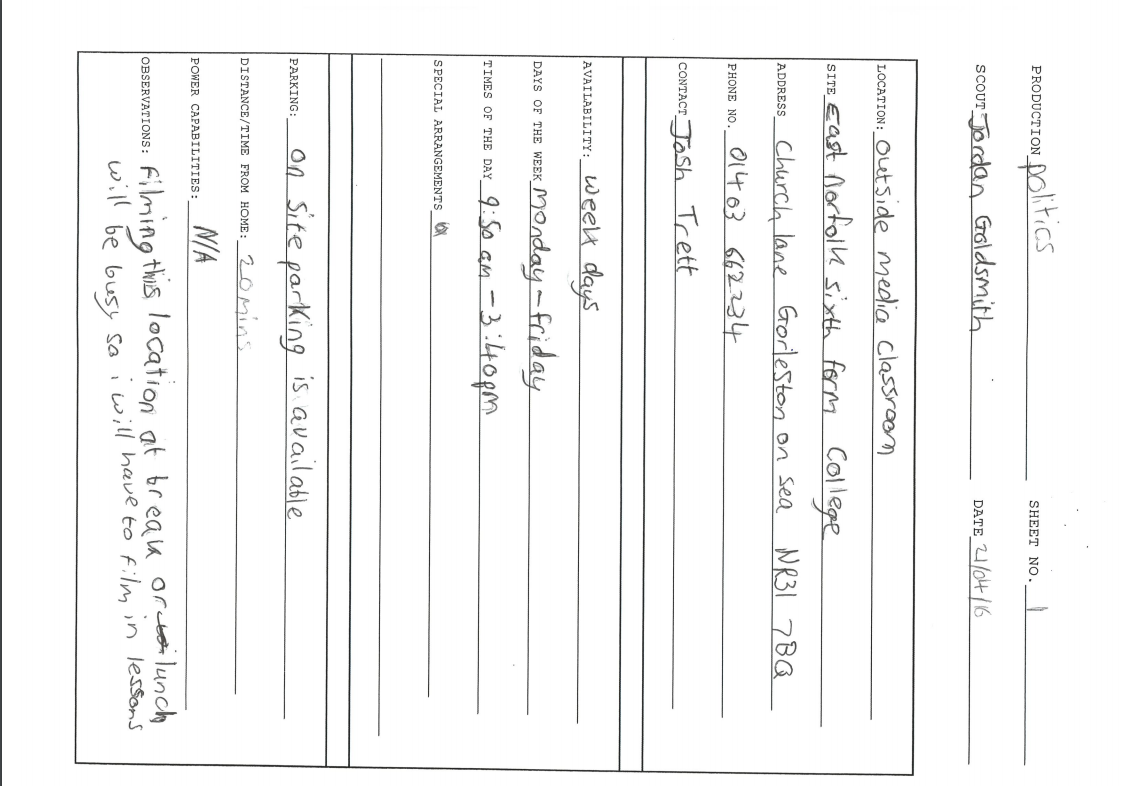
The location Recces are to scout the filming location to see if it is appropriate for what is needed for. It has details of the location so when looked back on the scout will remember as they filled this form out.  

The location releases is a agreement between the owner or someone allowed to give that authority to let the filmmaker use their site to film for a production.


 Talent releases are an agreement between and parent or guardian to let the son/daughter be filmed. if the talent is over 18 he can sign instead of a parent.

3 minute wonder - Proposal

My three-minute wonder idea is to find out how much Teenagers really know about politics and the perception that teenagers do not know nothing about politics. I will do interviews with teenagers and ask them how much they know about politics and if they think the idea of teens not knowing politics is fair or not.

The documentary format I will use is Reflexive and will use this as I will interview different people giving their personal opinion and their opinion may not be very reliable meaning whatever their opinion is the audience will have to have their own opinions based on what they saw and will make them think about if they agree or disagree with what the interviewee has said. The genre is special interest are politics is a subject that most wouldn't find entertaining and it’s not really educational as it would have to teach something however I am using random students who may know nothing on politics meaning they wouldn't be able to teach anything. 

The primary target audience would be Teenagers or Students, people with the age gap of 16-21 and this is because the documentary is based on people that age and is questioning their knowledge which may get them to watch as they would like to hear about how they are perceived. My secondary target is older people (60+) who are retired as these are typically the type of people who watch a lot of documentary and may be interested in how much knowledge younger people have. They could also use it to look back at their childhood and compare if they knew more.

I hope to show the population that the younger audience aren't completely clueless on what is going on in politics because Adults typically presume that they don't which isn't accurate and most of younger people are knowledgeable enough to understand politics. I also hope that I can prove that not all of the younger population as idiotic as others as stereo-typically older people would judge our generation as uninformed and not bothered in politics. 

I will not need to go anywhere I can’t walk so I will not need to go far. I may use different locations for each interview, however I won’t have more than four interviews as I won’t have enough time. I will use locations down the high-street and around that area or the college.

I will use interviews and do not need an expert as this is supposed to show if the target audience is knowledgeable and their opinions on the topic. I will use up to four interviewees however I may only use three as I’m not such if I can all of the questions in for four people so I will most likely used three.

I plan on doing interviews for the duration of the 3 minutes. The question I will ask first is their opinion of politics and how much they know and if they are interested in the topic. I will then go onto ask their opinion on students as a whole on their knowledge to see it the interviewees think other students have the same knowledge as them. I will then go on to ask how they find out their politic news and if they think the younger audiences should be taught by teachers or find out news themselves if they are interested. I will end on the question do they think knowing about politics is important and why they have that opinion.

I will not need much equipment apart from one of the colleges camera and tripod and possibly a microphone that the college also should be able to provide. I will not need any props that I can think of. Costumes will not be needed either however I may ask the interviewee to dress a certain way to make it look I am targeting different audiences. As I’m using the college equipment it is already there waiting to be used. Currently there is nothing I need to buy. The proposed budget is £5 which right now I have used none of and this can be used anything to help out the production apart from petrol if I need to go anywhere far away, however I don't plan on going anywhere far.      

Secondary Research

News report (http://learningenglish.voanews.com/content/are-16-17-mature-enough-to-vote/3247882.html)- This is a news report about the age to vote being lowered in the state of Ohio but the rest of the united sates is still 18 minimum. It follows up the facts with quotes from the youth of that state, it had mixed reaction with some saying that they are disappointed that they still aren't old enough and some saying that i'm old enough but i don't know enough to make a good decision.


Report (http://www.bbc.co.uk/guides/zsbtbk7)- This is a report by someone at the BBC and explains the positives and negatives to the age to vote being lowered to 16 and goes over different parts of the topic giving you the chance to make your own decision at the end o the report.


Documentary (https://www.youtube.com/watch?v=q9mdNmep-ZE)- This is a four minute clip from a hour long documentary about the age to vote and if lowering is a good idea. In this it has a young actor go on a road trip and discuss the topic with experts.    

Wednesday, 27 April 2016

3 Minute Wonders - Research

A 3 Minute Wonder is a type of documentary that only lasts 3 minuets. Channel 4 have a short three minute slot in prime-time television to let lesser known directors to get some screen time with their short three minute documentary's. The aim is to give a first time director some recognition and see if they have what it take to be a film director. In three minute wonders you would expect to see non-fictional life story's of people and their issues and how they overcome them. This can include medical issues or disabilities and would show what the person would have to deal with day to day. it essentially revolves around real people and real problems.

The is our youth-Carrot crew
This is a good three minute wonder as it takes a serious topic in unhealthy eating and makes a joke out of it, however it still is real meaning that people in it are actually trying to get their message out and in some ways promotes healthy eating by depicting the healthy eaters as the protagonists and the unhealthy eaters as antagonists. this has taught me that it doesn't have to be completely serious and that these 3 minute wonders can also show a lighter side.

3 minute wonder- Gemma
This is a good as it looks at very sick individual and shows that shes still human and still makes jokes and still has personality. at the end of this she talks about how not only that she is getting though it but she helps others getting though it by trying to cheer them saying that they can all get through it. This was inspirational which is the best thing going for as it shows even people in the worst position can still be happy. I learnt how much a director can use inspiration in their work to get through to the audience.

 Karl Pilkington - Nature
This is good as there is not much to it just a man complaining about nature and relative footage in the background to what he is saying. the idea is simple yet effective not only giving things to think about but to argue about as he hasn't got the best view on nature which could bother some people. i learnt that an 3 minute doesn't need to be some big idea it can just be some complaining at the camera, however most of the entertainment comes from the actor as he has a great way of complaining and is a very entertaining guy.


Factual Programme Questionnaire


Create your own user feedback survey


I wanted a balance of male and females getting it as even as possible to show that i'm not being bias by picking one specific gender as this is for students and not a particular gender. I got an odd amount of responses however it has an even amount on each as best as possible with 6 males and 5 females. this shows that is got a wide range of people including different genders.


I didn't want the age above 24 as my primary target audience are the younger audience 15-24 year old's. I purposely found people within my age gap and didn't get anyone older. I also wanted all of the responses for occupation to be student as that is my primary targets occupation a large amount of the time. I did get 100% of my responses as Students. I sent my questionnaire to only my primary audience and I only got ages under 16's to 24 year old's apart from one person who didn't take it seriously and put there age as 55-64 so discounting that I manage to only get my age gap. this proves i'm only targeting the people this is aimed.


This question i planned on getting either Yes or No as this is an opinion and it doesn't matter as long as not all of the answers are no there is still some interest in the topic of my documentary. i didn't really want 100% on either of the answers as that would have shown that I didn't get a wide enough audience. On this question I got more  yes than know which surprised me. This shows there is enough interest in the topic.


These questions are also a opinion and doesn't really matter what the outcome is as either way i have a good idea on what to talk about in the documentary. This shows that people believe that  teens don't know about politics which is something i could use as a comparison in the documentary. This is what i expected and am happy as i can discuss this in he documentary.


This is another question where the outcome is just something for me to quote in the documentary and doesn't matter what responses i get. This question was a little bit more mixed and is another point that i can discuss this in the documentary I expected this answer and is giving me the the point of the documentary being to find out if teens do know politics despite other thinking they don't.  


I needed enough people to be interested in this i otherwise i would have had to change my idea to something that people would be interested in. I got a mixed reaction with most of them being positive meaning i can go ahead with my idea as my responses show interest. I wasn't surprised however i was hoping that it was positive so i could go ahead with my idea.


The responses are not very important as most people would have a negative opinion on politics which is something i may discuss in the documentary. This question has different kind of responses with most being negative showing that politics as a topic doesn't have a good reputation. I can address the negative attitude in the documentary.


This question will have an outcome of me choosing certain people in the documentary to have a different level of knowledge rather then having the same level of knowledge and all of the answers being the same. This question is extremely mixed with Some knowledge coming out on top meaning that most people have a basic knowledge. In my documentary i will use people with different knowledge levels to get a better overall rather than just the knowledgeable.


The outcome of this question could be used in the documentary as a quote. This is another topic i can bring up in the documentary and have this addressed in the interviews. Most of the responses say through education which shows how they would have wanted to be taught that in school.


Thursday, 11 February 2016

The act of killing

What is the film about?
The film was about the mass killings in Indonesia told by the killers perspectives . The killers were asked to reacted the horrifying events that they committed but after the killings they were seen as heros for what they had done and was proud of what they had done.

The scene that stood out to me was the last couple of scenes in which one of the killers put himself in the perspectives of the people he had killed and they after all the years of thinking he was a hero he realised that what he had done was awful. he then proceed to go back to the place he did his killings and started to gag and be sick remembering all the lives he had taken.

The director had some persense during the film with the killers and people in front of the camera asking him questions for time to time. The director had no part in front of the camera and had no voice overs about his view on the subject.

There was a sequel to the act of killing which was called the look of silence and was about an optician who confronted his brother killers who was killed during the Indonesian genocide. It is essentially giving a perspective from the other side of the genocide.